


I spotted two women and two dogs approaching and quickly stepped off the narrow path, retreating into the woods. I got my dog Ralph’s attention and tried to keep it as they came closer.
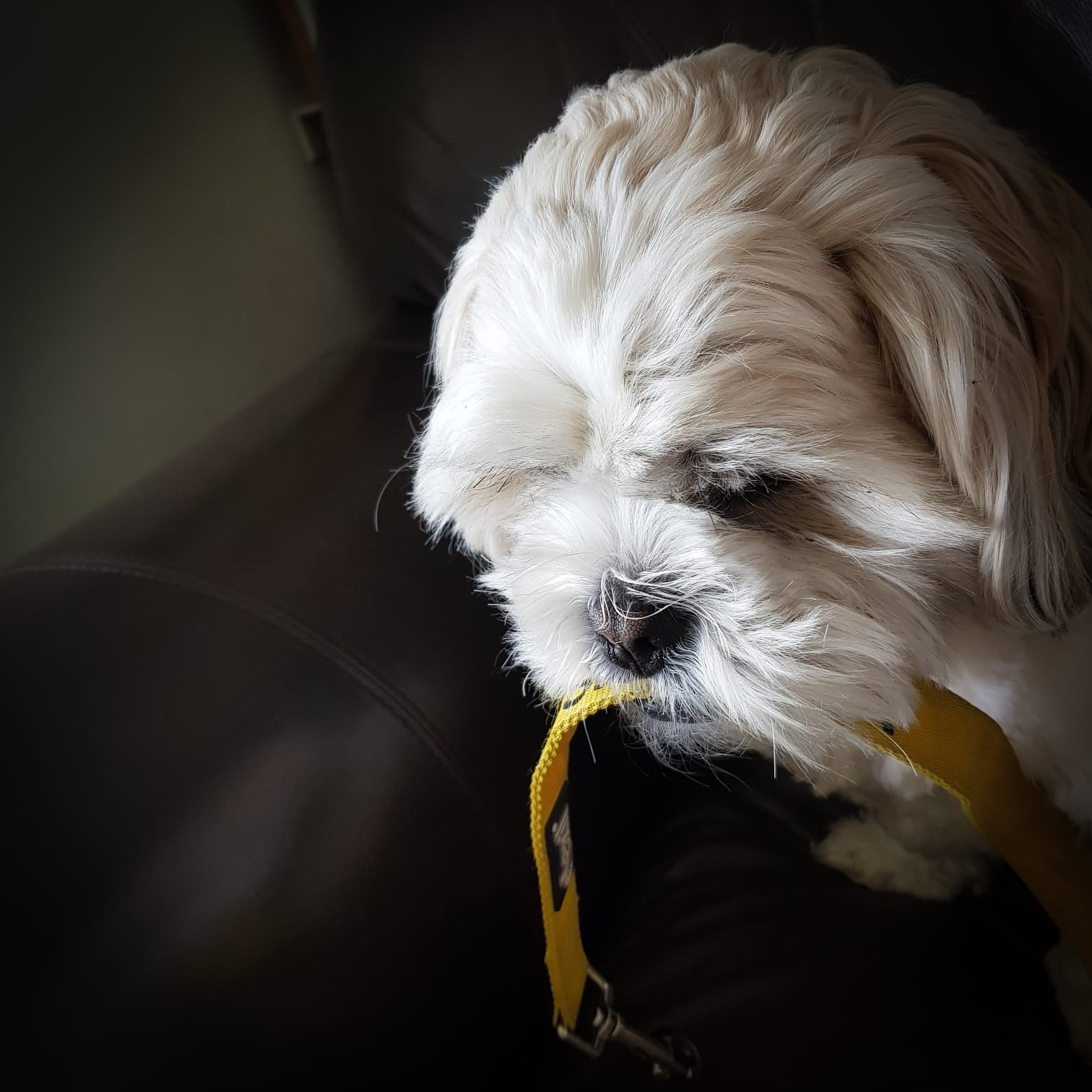
The pug and the longhaired terrier started bounding towards us. I called out to the women, using a phrase which was so difficult for me to use when I first started dealing with Ralph’s reactivity: ‘could you call your dogs please?’. It seems so presumptuous to ask strangers to do something for me. I’m bad enough at asking good friends for anything.
They called their dogs but the pug and terrier didn’t even look round as they starting circling me and trying to get nearer to Ralph, who by now was snarling between my legs and trying to lunge at them. The women finally came over to take their dogs away by the collar and as they did one of them said,
‘He’s feisty, isn’t he.’
My anger surged up. I wanted to say, he wouldn’t be feisty if your dogs hadn’t just totally disrespected his very clear signals and come right up into his face!
In this moment, I did manage to say ‘He’s just scared.’
This was my way of saying ‘no’ to this woman’s blaming of Ralph. I could have worded it better. I could have pointed out more clearly that it was her dog’s lack of recall that had led to this problem. I wanted to tell her about Ralph’s traumatic puppyhood, and his extreme anxiety that led to him lashing out. I wanted her to know that he was a beautiful, loving dog, and that I was a good owner and had done lots of training with him. (The truth is that I also had parts that felt ashamed of his growling, and ashamed of myself for not being able to do more to change him. But that is a different story.)
Nevertheless, I was proud that I had managed to speak up. A small boundary - a small ‘no’. They went on with their walk, probably oblivious to my turmoil, and I calmed my own fast-beating heart and my agitated dog so we could go on with ours.

I know that I’m not the only one who sometimes finds it hard to set boundaries, disagree with people, or stand up for myself (or my dog). What gets in the way of my ‘no’?
There are two ‘main players’ in my own struggles with saying no - an angry part of me, and a people-pleasing part of me (I actually have a big team of people-pleasing parts 😬). You can read more about different parts and the magic of Internal Family Systems (with puppies) here.
The angry part of me has information about when one of my boundaries has been breached. This could be minor, like my friend mildly misunderstanding me, or major, like someone swearing at me or threatening me.
As I get older, I have more appreciation for this angry part. Sometimes I experience it as anger, and sometimes I just experience it as a strong clarity. It has wisdom. In her book ‘See No Stranger’, Valarie Kaur speaks of the usefulness of anger or rage. In her childhood she was led to believe that rage was the opposite of love.
The opposite of love is not rage. The opposite of love is indifference. Love engages all our emotions: Joy is the gift of love. Grief is the price of love. Anger is the force that protects that which is loved. We cannot access the depth of loving ourselves or others without our rage.
Anger is the force that protects that which is loved. Kaur says that this anger, when contained within suitable limits and when (ideally) communicated with clarity and kindness, is a tool of love. This is the ‘no’ that leads us to safety.
In my own system, however, this clear and wise anger gets squashed and pushed away by my people-pleasing parts. The agenda of these parts is: keep other people happy with me at all costs. It’s better that I swallow my own annoyance, and put up with whatever it is that’s happened, than risk the other person getting upset with me.
This desperate agenda is rarely in proportion with the current situation (e.g. it wouldn’t actually matter if those two women with the dogs got upset with me). It originates from young childhood when I was entirely dependent on my caregivers and when my survival kinda did depend on them not getting upset with me and rejecting me.
The people-pleasing parts shut me up, which means that the anger gets even more angry, to try and push through the people-pleasers. The polarisation gets bigger and bigger.
So when our clear ‘no’ gets stopped by other parts of us, what can we do about it?

If we can only say ‘no’ by forcing our people-pleasing parts to shut up and allowing the anger out, then we are not moving towards safety. Now it’ll be our people-pleasing parts who don’t feel respected and safe!
The secret is to make a bigger space inside us where we can welcome ALL parts of us - the angry boundary-violation ones, the people-pleasing ones, and all the other parts that are involved in negotiating our safety with others and with ourselves.
First we notice that they are active. Then we find our curiosity and our compassion towards them. Then we let them know that we see them, and wait for them to share more about their experience. When they feel understood, they will be more likely to trust small changes. The secret is to go gently, bringing all our parts along, and maybe starting with very small ‘no’s.
It might also help to observe and emulate people whose boundary-setting we admire, read or listen around the subject, be honest with good friends and see if they’re up for our practising on them, and holding onto the idea that change is always possible.
Sometimes we are clumsy when we’re practising new skills, and we go to opposite extremes before we find a middle way. That’s okay. Sometimes others will push back strongly when we set new boundaries, because if we change it feels to them like we are forcing them into their own change. We are not - we are just putting down what we’ve been carrying for them - maybe for a long time. This offers them an opportunity - it is up to them whether they take it. We are only ever in charge of our own behaviour (and often not even that).
As we learnt last month, we all have limits. They are what make life juicy, and what make each of us unique. Acknowledging these limits and following up with a kind but firm ‘no’ will free you to a thousand wonderful yeses. Are you ready to spit out those poisonous black seeds? Are you ready to stand up for yourself?
Bring it on!
Love, Satya <3

Tell me: When is it most difficult for you to say no? To whom, or about what? What consequences does this have for you? What are you most afraid of? How might you get to know these afraid parts and support them to feel safer?
If you would like to get better at saying ‘no’ and increase your safety, become a paid subscriber to receive the rest of this month’s/year’s pieces. My lovely paid subscribers make it possible for me to write these pieces at all. Next week we’ll look at how to increase safety when saying ‘no’ doesn’t make any difference, and next month we will be looking at saying ‘yes’! I offer low cost subscriptions if needed, read more here.
Lyn Lifshin’s kick-ass poem The No More Apologizing, The No More Little Laughing Blues has been described as “among the most impressive documents of the women’s poetry movement”, and it has always been important to me. It socked me in the gut when I first read it. I couldn’t find the text anywhere online and so I bought a hard copy of the poetry collection it was in (Before It’s Light) so I could copy it out. I’m aware of copyright so rather than sharing the whole thing here I’m happy to share it individually with anyone who wants to read it (satya@satyarobyn.com). Here are the last few stanzas.
……………..
Look, I still have trouble saying
no. I want all of you to
care about what I’m thinking,
maybe even to
want my hair
It’s true, I put a no smoking sign up
on the door but twice I have
gotten out ashtrays
But I have stopped being grateful to
be asked to read
or to always have some
lover right there
beside me
it’s still not easy to get off the
phone, tell a young stoned poet
it’s a bore to lie with the
phone in my ear like a
cold rock while he goes on
about the evils of money,
charging it to my phone
But now when I hear myself laughing
the apologizing laugh, I know what
swallowing those black seeds can
do and I spit them out. Like tobacco.
(something men could always
do) Nothing good grows from the
I’m sorry, sorry, only those dark
branches and they will
get you from inside
~ Lyn Lifshin

I hear you!
Brilliant Lyn Lifshin! Thank you Satya, this is so clear and helpful. Ringing like a bell through me right now x